Ductile Iron Pipe Fittings for Water Supply & Sewerage Projects
Have you ever wondered why some water pipeline networks last for decades while others start leaking within a few years?
The answer often lies in a detail that frequently goes unnoticed—the quality of the pipe fittings. Even the most robust pipes cannot deliver optimal performance if the fittings connecting them are weak, poorly designed, or unsuitable for the project. Whether it is a municipal water supply system, an industrial pipeline, or a sewage network, every single connection is crucial. At Shree Krishna Industries, we understand that the success of your project hinges on reliability, not guesswork. As an experienced manufacturer of Ductile Iron pipe fittings for water supply projects, we produce high-quality fittings that help government bodies, contractors, and infrastructure developers across India build strong, leak-resistant, and durable pipeline systems.
Why Are Ductile Iron Pipe Fittings So Important?
Think about a water distribution network. Thousands of litres of water move through it every hour. Pressure changes, soil movement, vibration, and weather continuously test every joint.
If even one fitting fails, the result may include:
- Water loss through leakage
- Expensive repair work
- Service interruptions
- Increased maintenance costs
- Reduced pipeline life
That is why engineers prefer ductile iron instead of conventional cast iron for modern infrastructure.
What Makes Ductile Iron Different?
Unlike traditional cast iron, ductile iron combines high strength with flexibility. It resists cracking under heavy loads while maintaining excellent durability.
This means your pipeline can better handle:
- High internal water pressure
- Ground settlement
- Traffic loads
- Temperature variations
- Long-term operation
For municipal and industrial applications, this balance of strength and toughness makes ductile iron one of the most trusted materials worldwide.
Where Are These Pipe Fittings Used?
Our ductile iron pipe fittings for water supply projects support critical infrastructure where reliability cannot be compromised.
Common applications include:
- Municipal drinking water networks
- Rural water supply schemes
- Industrial water distribution
- Irrigation systems
- Fire protection pipelines
- Sewerage and wastewater projects
- Urban infrastructure developments
No matter the project size, choosing quality fittings today helps you avoid costly failures tomorrow. That is why we focus on manufacturing dependable water infrastructure pipe fittings that deliver consistent performance throughout the pipeline’s service life.
Types of Ductile Iron Pipe Fittings We Manufacture
Not every pipeline follows a straight path. Water networks pass through roads, buildings, treatment plants, pumping stations, and uneven terrain. Every bend, branch, connection, or change in pipe size requires a fitting that performs just as reliably as the pipe itself.
We manufacture a wide range of ductile iron pipe fittings for water supply projects designed for demanding infrastructure applications. Every fitting is produced with precision so your pipeline remains secure under varying pressure and operating conditions.
Flanged DI Fittings for Strong, Secure Connections
When pipelines require easy installation, inspection, or future maintenance, flanged DI fittings become the preferred choice. Their bolted connection provides excellent sealing while allowing sections of the pipeline to be dismantled whenever necessary.
Our flanged fittings are widely used in:
- Water treatment plants
- Pump houses
- Industrial utility pipelines
- Municipal water pipeline components
- Valve and meter installations
They help reduce installation challenges while providing dependable long-term performance.
Essential Pipe Fittings Used in Water Infrastructure
Every water supply network depends on multiple fitting types working together. Selecting the right component improves water flow, minimises leakage, and extends the overall service life of the pipeline.
Our product range includes:
- Double Flanged Bends
- Duck Foot Bends
- Tee Pieces
- Crosses
- Reducers
- Flanged Adaptors
- Socket and Spigot Fittings
- Blank Flanges
- Couplings
- Repair Sleeves
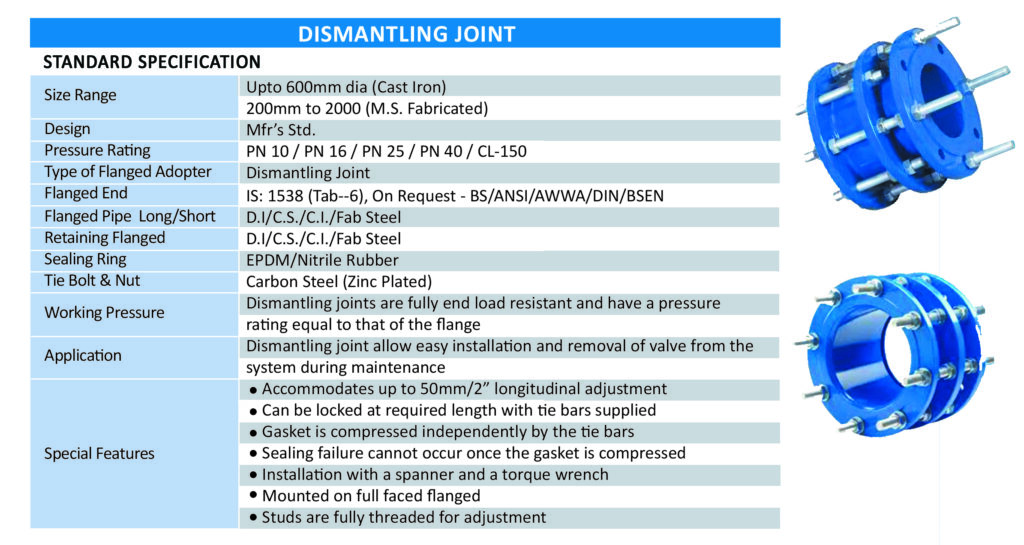
- Dismantling Joints
- Custom-designed fittings for project-specific requirements
Each component is manufactured to maintain dimensional accuracy, making installation smoother and reducing alignment issues at the project site.
Reliable Sewerage Pipeline Fittings for Tough Conditions
Sewerage systems face challenges that are very different from drinking water pipelines. Continuous moisture, corrosive environments, soil pressure, and fluctuating flow demand fittings that remain dependable year after year.
As a trusted sewerage pipeline fittings manufacturer, we supply ductile iron fittings suitable for:
- Underground sewer networks
- Stormwater drainage systems
- Wastewater treatment plants
- Industrial effluent pipelines
- Urban sanitation infrastructure
These fittings are engineered to withstand demanding environments while helping municipalities reduce maintenance costs over the long term.
Why Engineers Continue Choosing Ductile Iron
When planning a new pipeline, engineers often compare several materials before making a decision. Although alternatives may appear economical initially, long-term performance tells a different story.
Feature | Ductile Iron Pipe Fittings | Conventional Alternatives |
Mechanical Strength | Excellent | Moderate |
Pressure Handling | High | Lower |
Impact Resistance | Excellent | Limited |
Service Life | Very Long | Comparatively Short |
Maintenance Requirement | Low | Higher |
Suitability for Municipal Projects | Highly Recommended | Depends on application |
Because of these advantages, ductile iron pipe fittings for water supply projects remain the preferred choice for modern water infrastructure, offering dependable performance, lower lifecycle costs, and greater confidence for engineers, contractors, and public utility authorities.
How We Supports Modern Water Infrastructure Projects
Building a reliable pipeline is not just about supplying fittings. It is about making sure every component performs consistently once the system goes underground. We work with contractors, consultants, government bodies, and infrastructure developers to deliver pipe fittings that match real project requirements—not just catalogue specifications.
Whether you are expanding a city’s drinking water network or upgrading an ageing sewer line, we help you choose the right fittings for long-term performance. Our focus is always on quality manufacturing, dimensional accuracy, and dependable supply.
Choosing the Right Ductile Iron Pipe Fittings for Water Supply Projects
Before placing an order, it helps to evaluate more than just price. The right fitting reduces maintenance, prevents leakage, and keeps your pipeline operating efficiently for years.
Consider these factors:
Check Pressure Ratings
Every pipeline operates under different pressure conditions. Select fittings that match your system’s working pressure to avoid premature failure.
Verify Dimensional Accuracy
Poorly manufactured fittings create alignment problems during installation. Precision-made fittings ensure faster assembly and better joint performance.
Select the Correct Joint Type
Depending on your project, you may need flanged DI fittings, socket and spigot joints, or mechanical joints. Choosing the correct connection simplifies installation and future maintenance.
Look for Corrosion Protection
Water supply and sewerage pipelines often remain underground for decades. Protective coatings improve durability and reduce corrosion in challenging environments.
Work with an Experienced Manufacturer
An experienced sewerage pipeline fittings manufacturer understands project specifications, production consistency, and delivery schedules. This gives you confidence that every fitting will perform as expected.
Why Many Infrastructure Projects Choose Us
We know that delayed deliveries or inconsistent quality can slow down an entire project. That is why our manufacturing process focuses on precision, consistency, and timely execution.
When you work with us, you benefit from:
- Wide range of ductile iron pipe fittings
- Precision-engineered manufacturing
- Consistent product quality
- Reliable supply for large infrastructure projects
- Support for municipal and industrial pipeline requirements
- Competitive pricing without compromising quality
- Experienced technical manufacturing team
Our goal is simple—to help you build stronger, safer, and longer-lasting pipeline networks.
Build Reliable Pipeline Networks with Shree Krishna Industries
Every successful pipeline begins with dependable connections. Whether you need ductile iron pipe fittings for water supply projects, flanged DI fittings, or durable solutions for sewerage infrastructure, we are committed to delivering products that combine quality, strength, and long-term value.
Partner with Shree Krishna Industries to source precision-engineered pipe fittings that help your water infrastructure perform efficiently for decades.
FAQs
What are ductile iron pipe fittings used for?
Ductile iron pipe fittings connect, branch, reduce, or change the direction of pipelines in water supply, sewerage, irrigation, industrial, and municipal infrastructure projects.
Why are flanged DI fittings preferred?
Flanged DI fittings provide secure, leak-resistant connections while making future maintenance and equipment replacement much easier.
Are ductile iron fittings suitable for sewerage systems?
Yes. Their high strength, impact resistance, and corrosion-resistant coatings make them an excellent choice for underground sewerage and wastewater pipeline networks.
How do quality pipe fittings improve water infrastructure?
High-quality water infrastructure pipe fittings reduce leakage, improve system reliability, minimise maintenance costs, and increase the overall service life of the pipeline.
Does your foundry manufacture PHE approved pipe fittings?
We manufacture high-quality PHE approved pipe fittings that are designed to meet the requirements of government water supply and infrastructure projects, subject to the applicable project specifications and approval requirements.