Looking for a Manhole Cover Manufacturer in India? You have probably seen dozens of suppliers online. Most tell you the same things: strong products, competitive prices, international quality and worldwide delivery. But when you’re actually buying 500, 2,000 or 10,000 manhole covers, the questions become very different.
Will the dimensions match your drawing?
Does the load class meet your project specification?
What material grade are you getting?
What documents will you receive before shipment?
And what happens if the product reaches your site and doesn’t fit?
That’s what you should solve before placing the order.
Why Buy Manhole Covers from India?
India has a large foundry and engineering base, making it a practical sourcing location for cast iron and ductile iron infrastructure products. Indian manufacturers supply different types of covers and gratings for municipal, drainage, road, utility and industrial applications. Competitors in the Indian market currently promote exports to Europe, the Middle East, the USA and other international markets. But price should not be your only reason for sourcing from India.
Your real advantage comes from finding a supplier that can consistently deliver the right specification, repeatable dimensions and suitable documentation.
What Should You Send to an Indian Manufacturer?
This is where many first-time buyers lose time. Don’t email: Please send your best price for D400 manhole covers. That leaves too many questions unanswered. Instead, give your manhole cover manufacturer in India the following:
- Required standard
- Load class
- Clear opening
- Overall frame dimensions
- Cover shape
- Material specification
- Quantity
- Drawing or technical specification
- Locking requirement
- Hinge requirement
- Coating requirement
- Marking or logo requirement
- Delivery destination
- Required documentation
A proper enquiry lets the supplier quote against the same specification you’re using internally. That makes supplier comparison much easier.
Which Load Class Do You Need?
Don’t choose a cover simply because the supplier calls it “heavy duty.”
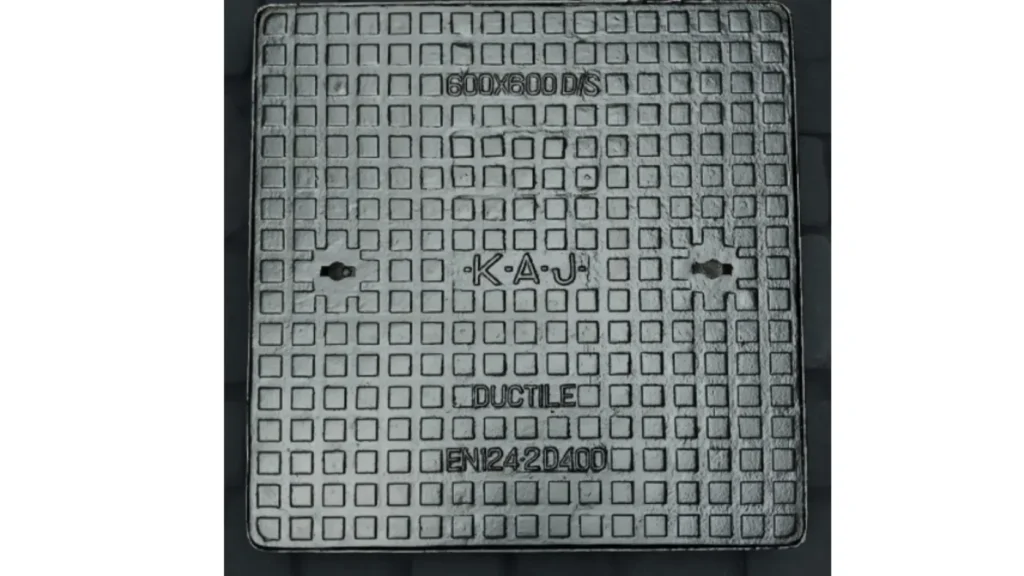
For EN 124 applications, the commonly referenced classes include A15, B125, C250, D400, E600 and F900.
The appropriate class depends on the installation location and expected loading.
For example, D400 is commonly associated with carriageways and areas exposed to vehicular traffic, while E600 and F900 are intended for progressively higher wheel loads.
If you’re working on a road project, tell your supplier that upfront.
If you’re buying for an airport, industrial yard or port, provide the project specification rather than asking the manufacturer to guess the required class.
Ductile Iron or Cast Iron?
This is another question you should settle before comparing prices. Ductile iron manhole covers are widely used where strength, impact resistance and load-bearing performance are important. Cast iron products are also widely used in municipal and infrastructure applications.
The important point is this:
Don’t compare two quotations until you know they’re offering equivalent materials and specifications.
A lower price may simply reflect a different material grade, weight, coating, design or accessory configuration.
Some Indian manufacturers currently specify ductile iron using EN or ASTM-related material grades and offer multiple load classes and configurations.
What Should European Buyers Check?
If your project is in Europe, the first question is usually the governing standard.
For an EN 124 manhole cover manufacturer, ask for the exact standard and product specification applicable to your project.
Then confirm:
- Load class
- Material grade
- Clear opening
- Frame dimensions
- Cover weight
- Locking system
- Hinge arrangement
- Surface finish
- Testing requirements
- Required technical documents
Don’t assume that two products labelled “D400” are automatically identical.
The design, dimensions and project requirements still need to match.
What About Middle East Projects?
For buyers in the UAE, Saudi Arabia, Qatar, Oman and neighbouring markets, project specifications can vary considerably. Your consultant or municipality may have requirements beyond the basic load class. Before ordering, ask your project team for the approved specification. Then send that document to your manhole cover supplier in India. This is particularly useful for large infrastructure projects because it reduces back-and-forth between the consultant, contractor, procurement team and manufacturer.
What Should US Buyers Check?
Here’s where you need to be especially careful. A US project may not use EN 124 as its governing specification. Depending on the project, the buyer may need to work with ASTM, AASHTO, municipal or project-specific requirements. Indian suppliers serving North American customers do list ASTM-related specifications for cast and ductile iron products.
So don’t send: “I need an EN 124 D400 cover for America. Instead, ask your engineer or authority: Which standard and load requirement does this project require?
Then give that requirement to your manufacturer.
That one step can save you from ordering the wrong product.
How Do You Compare Indian Suppliers?
Price is important. It isn’t enough.
When comparing two manhole cover exporters from India, put their quotations side by side and check:
Check | Supplier A | Supplier B |
|
Don’t compare quotations by price alone. Make sure both suppliers are offering the same material, load class, dimensions, weight, frame, coating and accessories. A lower price may simply mean fewer items are included.
What Documents Should You Request Before Shipment?
Ask your supplier what documentation they can provide for your project.
Depending on your contract and destination, this may include:
- Technical drawings
- Product specification
- Material information
- Load-test documentation
- Inspection records
- Dimensional inspection
- Coating information
- Packing list
- Commercial invoice
- Certificate of origin
Other documents required by your contract or importing country
Don’t wait until the container is ready to ask for paperwork.
Discuss documentation before production begins.
What About Custom Manhole Covers?
Your project may not need a standard catalogue design.
You might require:
- Custom dimensions
- Recessed covers
- Hinged covers
- Lockable covers
- Airtight or watertight designs
- Special logos
- Utility markings
- Special frame arrangements
- Custom drainage gratings
Indian suppliers already advertise customised designs, markings, locking arrangements and different lifting options, showing that these are established procurement requirements in this market. If you have a drawing, send it.
A good manufacturer should be able to tell you what information is missing before quoting.
How Should Manhole Covers Be Packed for Export?
This is an often-overlooked question. Your covers may travel thousands of kilometres before reaching the project. Ask the supplier: How will the covers and frames be packed for international transport? Confirm the packaging method, stacking arrangement and protection against handling damage. For large orders, also discuss container utilisation before production. A product that is correctly manufactured but poorly packed can create unnecessary problems at the destination.
What About Drainage Gratings?
The same buying principles apply when sourcing from a drainage grating manufacturer in India. Tell the supplier:
- Where the grating will be installed
- Expected traffic
- Required load class
- Channel dimensions
- Clear opening
- Material
- Surface finish
- Locking requirement
- Quantity
- Project standard
Don’t simply order “heavy-duty drainage gratings. The installation location should determine the specification.
A Practical Example
Imagine you’re a contractor in Dubai sourcing covers for a new road project.
Instead of sending: Need 2,000 D400 covers. Best price?
Your enquiry could say: We require 2,000 ductile iron manhole covers for a road infrastructure project. Required clear opening: 600 mm. Load class: D400. Please quote cover and frame, including locking arrangement, coating, technical drawing, applicable testing documentation and export packing. Delivery: Dubai. Now the manufacturer knows what you’re actually buying. You can also compare competing quotations properly.
That’s how international procurement should work.
Before You Place Your First Order
Use this checklist: Confirm the governing project standard, load class, material grade, clear opening, approved drawing, frame dimensions, coating, hinge/locking requirements, and markings. Agree on testing/documentation, confirm packaging, quantity, delivery terms and production lead time, and approve the final specification before production.
Why Work Directly With Shree Krishna Industries?
At Shree Krishna Industries, we understand that an international buyer needs more than a product photograph and a price. You need the product to match your project. You need clear specifications. And you need communication that doesn’t leave important technical details to guesswork.
Whether you are sourcing ductile iron manhole covers, cast iron manhole covers or drainage gratings, share your drawing, specification or requirement with our team.
We can discuss the appropriate product configuration for your application and help you move from requirement → quotation → technical approval → production → shipment.
Ready to Source Manhole Covers from India?
Send us your required size, load class, material, quantity, project location and drawing/specification. The more we know about your project, the more accurately we can quote.
FAQs
Can I order D400 manhole covers for the Middle East?
Yes, provided D400 is the correct class for your project. Give the manufacturer your project specification, dimensions and required features before ordering.
Can manhole covers from India be supplied for US projects?
Potentially, but confirm the governing US project specification first. Depending on the authority, ASTM, AASHTO or municipal requirements may apply.
What is the most important information to send a supplier?
Start with application, standard, load class, clear opening, frame dimensions, material, quantity and destination. Add your drawing whenever possible.